

Young Researchers
Children and young people have the right to be heard on all matters that concern them, and research is one of those matters. When they are meaningfully involved, research can become more relevant, impactful, and grounded in their lived realities and priorities.
Queen Mary has developed a participatory research toolkit to support researchers working with children and young people. It was co-created with young people from Queen Mary and east London.
Participatory research seeks to collaborate with children and young people as co-researchers. While such approaches can be both rewarding and generative, they also raise practical, relational, and ethical challenges. The toolkit brings together reflections from young people, practical guidance, and case studies drawn from across Queen Mary’s research community to support researchers navigating this work.
At the heart of the toolkit is the expertise of the team of Youth Insight Researchers - young people who observed research in action, spoke with researchers and their peers, and contributed their own reflections and perspectives about what meaningful participation can look like in practice.
So, for anyone interested in doing research with children and young people, rather than simply about them, this resource is for you. It is freely available and serves as a foundation for training, reflection, and capacity-building in participatory research.
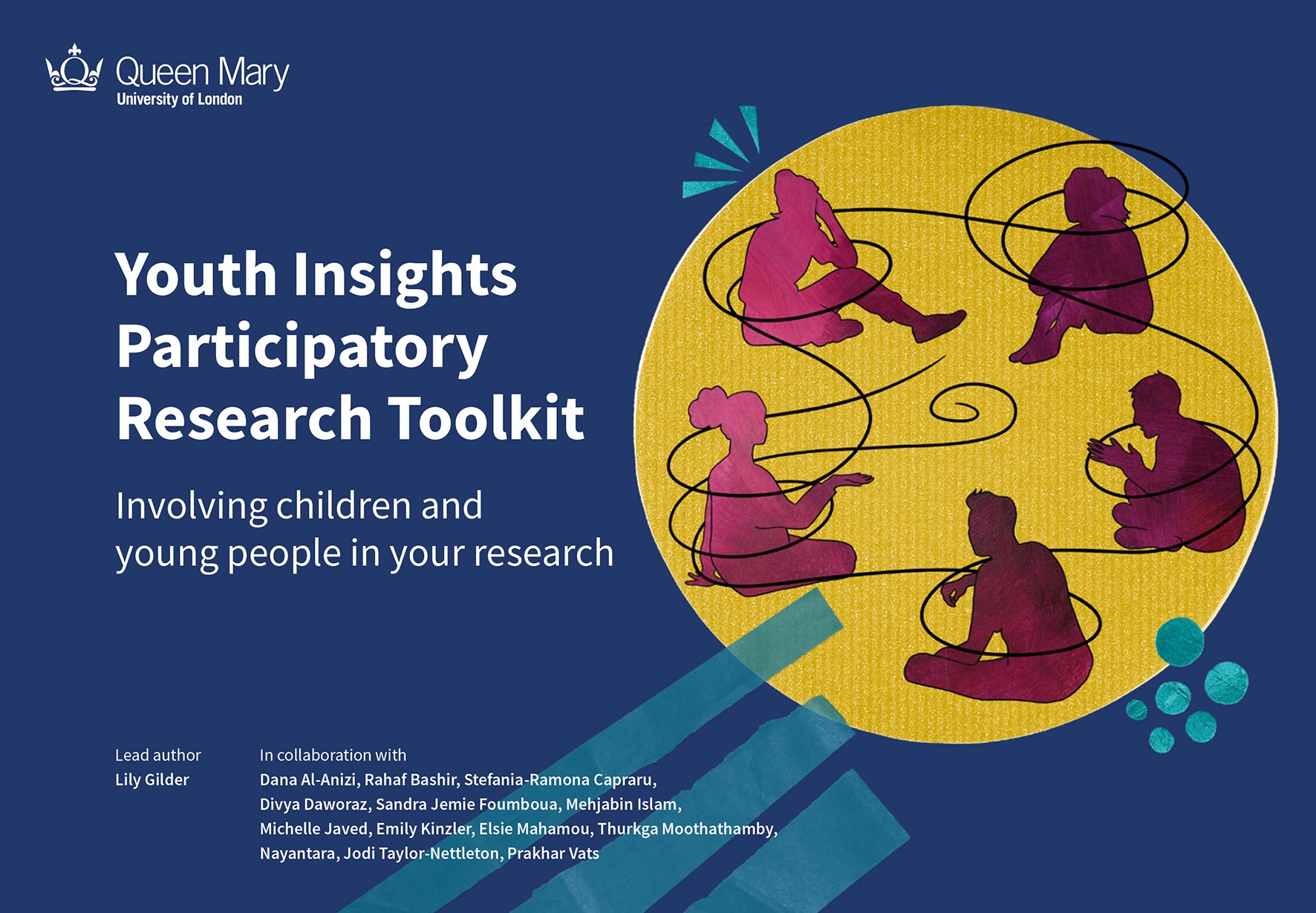
Youth Insights Participatory Research Toolkit [PDF 25,860KB]
About the project
This project explored how young people can play an active role in research and how their voices can be meaningfully included in knowledge production.
Young researchers aged 18-25 were embedded across a range of active research projects at Queen Mary, working alongside academics in fields including public health, mental health, creative arts, dentistry, and early years education.
Using the toolkit
The toolkit supports researchers to design and deliver child- and youth-centred participatory research. It explores:
- When and why participatory approaches might be appropriate
- How to design meaningful and ethical involvement
- Recruitment, relationship-building, and facilitation skills
- Working collaboratively with parents, schools, youth orgs and other 'gatekeepers'
- Navigating emotions, complexity, and uncertainty
- Working with creative methods
The toolkit encourages reflexive and thoughtful practice. Rather than presenting participation as a simple solution for more inclusive, engaged research, it explores the realities, challenges, and opportunities of working collaboratively across age groups.
As well as a practical guide, the toolkit can be used as a resource for training, reflection, and shared learning, supporting individuals and teams to build their confidence and capability in participatory research.
It can be used in a range of contexts, including:
- Workshops and training sessions
- Teaching and learning environments
- Peer reflection
- Community engagement and collaborative partnerships
Acknowledgements
The Youth Insights Participatory Research Toolkit has been developed by the Centres for Creative Collaboration and Public Engagement at Queen Mary University of London as part of Research England Participatory Research Funding.
Lead author: Lily Gilder, Youth Insight Participatory Research Officer, Queen Mary University of London.
Youth Insight Researchers: Dana Al-Anizi, Rahaf Bashir, Stefania-Ramona Capraru, Divya Daworaz, Sandra Jemie Foumboua, Mehjabin Islam, Michelle Javed, Emily Kinzler, Elsie Mahamou, Thurkga Moothathamby, Nayantara, Jodi Taylor-Nettleton, Prakhar Vats.
With thanks to the contributions of other youth researchers who informed and shaped this toolkit.
Additional resources
Toolkit launch webinar