
Exploring the future of learning with Moodle and Mahara
/filters:format(webp)/prod01/channel_389/technology-enhanced-learning-team/media/telt/images/cropped-cropped-Catalyst_Bolt.png)
Queen Mary were the recent hosts of the Catalyst Moodle Community Day. Catalyst are QMUL's Moodle partners and support us with QMplus.
The day brought together learning technologists, educators, and developers for a day of discussion, innovation, and shared practice. With a strong focus on Moodle (QMplus) and Mahara (QMplus Hub), the event explored not only the evolving capabilities of these platforms, but also the broader question at the heart of digital education: what does meaningful learning look like in an AI-enabled world?
Here is just a snapshot of some of the talks during the day.
An Update from Moodle CEO
The opening session of the day was an update from Moodle CEO Scott Anderberg. He started with a reminder of the vast numbers of learners who use Moodle across the globe. It is indeed a staggering number.
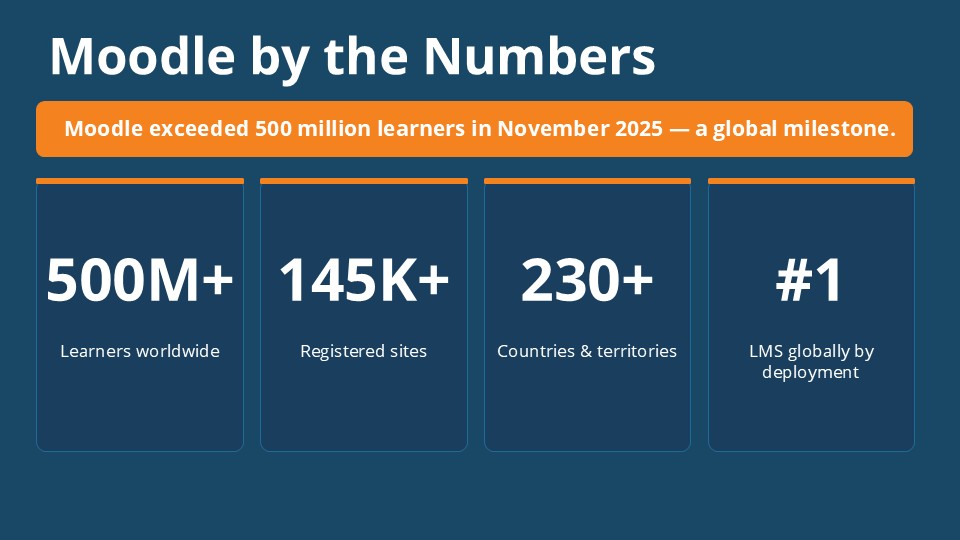
Moodle statistics
After mentioning some of the upcoming Moodle enhancements, such as a clearer course structure, improved assessment workflows, and a more intuitive dashboard, the technology talk turned philosophical. The hot topic, or perhaps luke warm as we've now been talking about it for quite a while, was AI. Anderberg made a key distinction between 'AI as a tool' and 'human intelligence as judgement'. Regarding his personal use of AI, he has started to ask himself 2 important questions:
- Am I sufficiently expert at this task to assess that the output is comprehensive and accurate?
- How much of my distinct personality, values, and individual worldview are required to produce the outcome I need?
This framing set the tone for the day: innovation must remain grounded in human-centred learning.
Anderberg also revisited Moodle's foundations in social constructivism, reminding us that it works when these things are present:
- Social Interaction - dialogue, debate, collaboration, curiosity, vulnerability, the conditions that make learning possible.
- The More Knowledgeable Other (MKO) - you can't always be the smartest one in the room if you want to learn anything.
- Reciprocal Teaching - Learners and MKOs co-create knowledge together.
In a world saturated with digital content, this emphasis on authentic human connection felt particularly relevant. And at a time when there is nothing social about 'social' media, human interaction and connection are as important as ever.
Anderberg also highlighted the Moodle approach to AI, which is very much in putting control into the hands of organisations. With Moodle, organisations have complete control over how they choose to integrate AI features into the platform, including which services they choose to use. This control matters more than ever as issues of security and data sovereignty become top priorities.
Moodle Roadmap
The Moodle roadmap reinforced a strong committment to:
- Accessibility and inclusion
- Empowering educators
- Fostering collaboration
- Unlocking creativity
A key takeaway was the challenge of 'learning commoditisation'. While AI can now generate content at speed, the real value still lies with human intervention - intentional, evidence-based learning design.
Multiple Marking Project - UCL
At UCL, learning technology and IT teams are addressing the challenge of handling large media submissions (up to 30GB). Their solution - a bespoke Moodle plugin that archives files to long-term storage - demonstrated how technical innovation can support evolving forms of assessment, such as immersive media and game-based projects.
Discussion followed on the Coursework plugin, developed by UCL and contributors. This plugin is something we are currently testing at QMUL and we hope to make it available for the 2026/27 academic year. The Coursework activity supports fully independent double marking directly in QMplus. This includes blind and open double marking workflows, complete marking history for audit and external examiner review, and third marker support when agreement cannot be reached. This is something that has not been natively available in QMplus (Moodle) up until this point, so the addition of this plugin is very welcome.
For further information about the Coursework plugin, please email TELT.
Mahara Group Assignment Submission - DCU
 A new group submission workflow, developed in collaboration with Dublin City University (DCU) and Catalyst, showcased how integration between Mahara and Moodle can better support collaborative learning. By streamlining group submissions and aligning workflows across platforms, this development addresses a longstanding pain point for educators.
The session highlighted the growing importance of group work in HE - not just for academic outcomes, but for building employability skills such as:
- Communication
- Teamwork
- Problem-solving
- Negotiation
Portfolio-based assessment, enabled by Mahara, was positioned as a powerful approach aligned with student-centred and inclusive learning design.
We will be making this new plugin available in QMplus for the 2026/27 academic year. Alongside the upgrade to the whole Mahara system happening on July 7th, Mahara will be much improved and we hope to see increased usage. Keep an eye out for more information in our TELT newsletter, or talk to your local Digital Education support team.
Tidying Up Your Data with the QMUL 'Moodle Teenager' Project
 A joint presentation from QMUL and Catalyst IT introduced the aptly named 'Moodle Teenager' project - a name that perfectly captures the reality of a platform that has grown (a bit messily) over 13 years. The focus here was on cleaning up QMplus and tackling the huge volume of outdated, duplicated, and inconsistent data that has built up over time.
The scale of the challenge was impressive - millions of pieces of problematic data - but so was the response. The team developed a 'sweeping' tool to audit, clean, and organise course data, making a real difference behind the scenes. In fact, some key milestones - like major upgrades and preparing for the new academic year rollover - wouldn't have been possible without it.
Beyond the technical detail, the session was a good reminder that data hygiene really matters. Keeping things tidy isn't just about organisation - it has a direct impact on system performance and the overall user experience. By removing old, orphaned content and putting better structures in place, the project is helping make QMplus more efficient and easier to use. The next step is to keep that momentum going, embedding these practices so the system doesn't end up back in 'teenager mode' again.
Learning at Scale: the Humanitarian Leadership Academy
The Humanitarian Leadership Academy shared an inspiring example of Moodle Workplace in action, through its Kaya platform.
Supporting nearly one million learners across 195 countries, Kaya demonstrates what's possible when learning technology is deployed at a global scale. Some statistics:
- 47 different organisations (charitable and commercial) under one platform
- 5,000 + courses (including 900+ publicly available for free)
- Multilingual content in 30 languages
- Hundreds of new learners joining daily
This highlights how a Moodle-based platform can enable accessible, scalable education, even in complex and resource-constriained contexts. Notably, the HLA's move to Moodle Workplace from Totara also resulted in a 60% reduction in support costs, underlining the platform's efficiency and flexibility, particularly through its dynamic rules feature.
From a QMUL perspective, Moodle Workplace could well provide the solution we seek for Short Courses and Executive Education.
Final Reflections
Across all sessions a consistent message emerged:
Technology should enhance - not replace - the human elements of learning.
Whether through AI-assisted design, collaborative portfolios, or global learning platforms, the focus must remain on:
- Purposeful learning design
- Human judgement and expertise
- Collaboration and community